El sonido en el cine

JULLIER, Laurent, El sonido en el cine, Barcelona, Editorial Paidós, 2007 (Le son au cinéma, Paris, Cahiers du cinéma, 2006).
http://www.virose.pt/ml/alunos/docs/JULLIER_El_sonido_en_el_cine.pdf
Outros textos novos
Textos novos para download (para lista completa ver link em cima à direita):
ATALI, Jacques, Noise: The Political Economy of Music , University of Minessota Press, Minneapolis, 1985 (Bruits: essai sur l’économie politique de la musique, 1977)
http://www.virose.pt/ml/alunos/docs/ATALI_noise.pdf
________________
KAHN, Douglas, Noise, Water, Meat, A History of Sound in the Arts, Cambridge (Mass.), MIT Press, 1999
http://www.virose.pt/ml/alunos/docs/KAHN_Noise_Water_Meat
___________________
NOWELL-SMITH, Geoffrey (ed.), The Oxford World History of Cinema, Oxford, Oxford University Press, 1996.
http://www.virose.pt/ml/alunos/docs/The-Oxford-History-of-World-Cinema.pdf
Vitaphone
Um dos primeiros sistemas de sincronização de som e imagem no cinema.


IMITATION OF LIFE de Douglas Sirk
O Clube Português de Cinematografia | Cineclube do Porto apresenta no dia 31 de Março (quinta-feira) às 22h, a sua próxima sessão regular no Cinema Passos Manuel:
IMITATION OF LIFE de Douglas Sirk
EUA |1959 | Ficção | 35mm | cor | 125’
A propósito de Michel Chion
A propósito de Michel Chion:
The Cut-Ups
O filme de Anthony Balch sempre está disponível na ubu web:
http://www.ubu.com/film/burroughs_cut.html

The Cut-Ups
1966, UK, 18′ 45″, Black & White
Cinematography: Antony Balch
Screenplay: William S. Burroughs
Cast: William S. Burroughs, Brion Gysin
John Cage – Williams Mix 1952
Para responder à pergunta da Raquel…
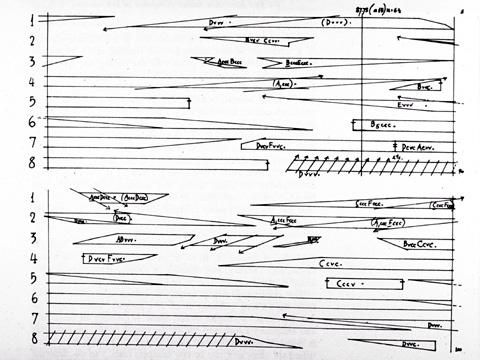
John Cage – Williams Mix 1952
Cage’s first composition for tape recorder already goes to the limits of the medium. Commenting on his score, Cage explains: “This is a score (192 pages) for making music on magnetic tape. Each page has two systems comprising eight lines each. These eight lines are eight tracks of tape and they are pictured full-size so that the score constitutes a pattern for the cutting of tape and its splicing. All recorded sounds are placed in six categories … Approximately 600 recordings are necessary to make a version of this piece. The composing means were chance operations dervied from the I-Ching.”
(Fonte: John Cage, Werkverzeichnis Edition Peters, New York 1962, p. 41.)
The only realization of this score to date was carried out by Cage himself. In spite of the assistance of Earl Brown and David Tudor, with editing and splicing the recorded tapes, completing this four-minute-long sound montage took approximately a year. Used for the premiere performance were 4 stereo tape recorders and 8 speakers.
Dieter Daniels
fonte: http://www.medienkunstnetz.de/works/williams-mix/
Ciclo de cinema MM: THEO ANGELOPOULOS
THEO ANGELOPOULOS – O ÚLTIMO MODERNISTA: O PASSADO COMO HISTÓRIA, O FUTURO COMO FORMA.
Numa colaboração da Medeia Filmes com a Faculdade de Belas Artes da Universidade do Porto (Mestrado em Práticas Artísticas Contemporâneas e Artes Plásticas – Multimédia), terá lugar, de 17 a 23 de Março, o ciclo THEO ANGELOPOULOS – O ÚLTIMO MODERNISTA: O PASSADO COMO HISTÓRIA, O FUTURO COMO FORMA, dedicado à obra do cineasta grego, com três dos seus filmes das últimas duas décadas e a estreia da sua nova obra, A POEIRA DO TEMPO.
TEATRO DO CAMPO ALEGRE
Tim Shore + Unabomber

Tim SHORE
Cabinet
Experimental film | dv, s8, 16mm | colour | 18’20” | United Kingdom | 2006
Tim Shore’s ‘Cabinet’ is a complex and multi-layered film which evokes humankind’s ambivalent relationship with history, memory and technology. The film uses the Unabomber’s Manifesto a
s its main subject, going beyond it by presenting to the viewer something simultaneously meditative and disturbing. Featuring several layers of images, sounds and texts, either original ones or chosen from archive material, this piece reminds the audience of the primary social constructions about America and its accompanying myths. It especially refers to the difficult and unsolved confrontation between the idea of its vast, pure and open spaces, and the highly complex and technological societies that have emerged from its exploration and occupation. In fact, Theodore Kaczynski’s wooden cabin which is being featured in ‘Cabinet’, is not so different, for instance, from President Abraham Lincoln’s log cabin. Both places are sort of backwoods, far away from big cities and from the influences of modern life; reminiscent of mythological and pure places from a bygone era. The precise use of sound, mainly appropriated from other sources, takes a primary role within the film. This happens in association with the presence of the contemplative and pictorial landscapes which come and go, as with the typewriter who haunts the film from the beginning, only to reappear close to the end in a moment when optic and acoustic data flows refuse to stop. Now, facing a black screen, a powerful sound somewhere between that of a typewriter and a machine gun resounds. Technology and its shadow take the lead in the blind construction of history.
http://flamin.filmlondon.org.uk/showcase/assets/showcase_items/cabinet
___________________
The Unabomber Manifesto
http://en.wikisource.org/wiki/Industrial_Society_and_Its_Future
textos para a aula de 14/03
Sugestões de leitura
GREENBERG, Clement, “Towards a Newer Laocoon”, in HARRISON, Charles e WOOD, Paul (Eds), Art in Theory: 1900-1990, Oxford, Blackwell, 1992, pp. 554-560 (orig. publ. in Partisan Review, VII, nº4, New York, July-August 1940, pp. 296-310).
http://www.virose.pt/ml/alunos/docs/GREENBERG_Towards_a_Newer_Laocoon.pdf
KITTLER, Friedrich A. (1986), Gramophone, Film, Typewriter [Grammophon, Film, Typewriter], trad. de Geoffrey Winthrop-Young e Michael Wutz, Stanford (CA), Stanford Universty Press, 1999.
Só a introdução: <http://www.virose.pt/ml/alunos/docs/KITTLER_Gramophone_Film_Typewriter_Introd.pdf>